

Artificial intelligence has become part of everyday life. From writing emails and generating code to brainstorming business ideas and automating workflows, AI assistants are changing how people work, learn, and create. But with so many powerful tools available, one question dominates the conversation in 2026:
Which AI is actually the best—ChatGPT, Claude, or Gemini?
The answer depends on what you need. Each platform has unique strengths, different personalities, and specific use cases where it shines. Some are better for creative writing, others for research, coding, or productivity.
This guide breaks down the real differences between these three AI giants so you can choose the right one for your goals.
Understanding the Three AI Giants
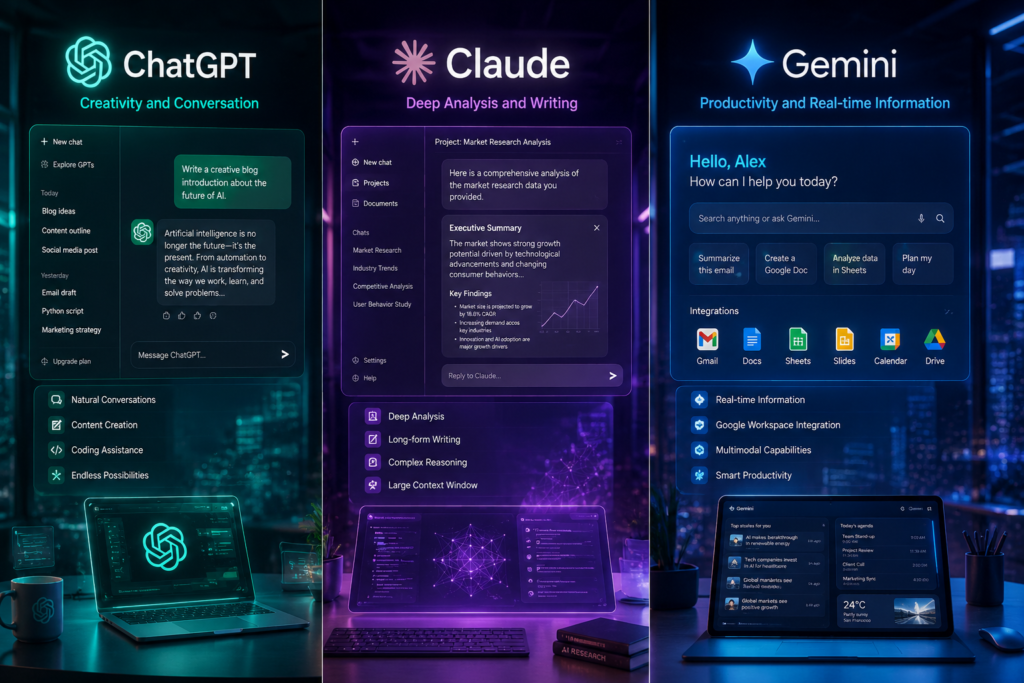
Before comparing features, it helps to understand what each AI was designed to do.
ChatGPT (OpenAI)
ChatGPT is the most widely recognized AI assistant in the world. Built by OpenAI, it became famous for its conversational abilities, versatility, and massive ecosystem of integrations.
It excels in:
- Writing and content creation
- Coding assistance
- Productivity workflows
- Research and brainstorming
- Conversational interactions
One of ChatGPT’s biggest strengths is flexibility. It can adapt to casual conversations, professional tasks, educational content, and technical projects with remarkable accuracy.
Best For:
- Bloggers
- Entrepreneurs
- Developers
- Students
- Marketing professionals
Claude (Anthropic)
Claude is designed with a strong emphasis on safety, clarity, and thoughtful responses. Many users describe Claude as more “human-like” in tone and better at nuanced writing.
Claude is especially strong in:
- Long-form writing
- Summarizing complex documents
- Deep analysis
- Context understanding
- Ethical and careful responses
It often feels calmer and more structured than other AI tools.
Best For:
- Writers
- Researchers
- Analysts
- Legal professionals
- Academic users
Gemini (Google)
Gemini is Google’s AI ecosystem powerhouse. Its biggest advantage is integration with Google services and real-time web-related capabilities.
Gemini performs well in:
- Google Workspace integration
- Search-based tasks
- Multimodal AI
- Productivity automation
- Real-time information access
Because it connects naturally with Gmail, Docs, Sheets, and Search, it is highly attractive for users already deep in the Google ecosystem.
Best For:
- Google Workspace users
- Teams and collaboration
- Productivity-heavy workflows
- Search-driven tasks
Feature-by-Feature Comparison
1. Writing Quality
ChatGPT
ChatGPT produces polished, engaging, and adaptable writing. It can mimic different tones, styles, and formats with ease.
It performs exceptionally well for:
- Blog posts
- Social media content
- Marketing copy
- SEO writing
- Storytelling
Claude
Claude often creates more natural and reflective writing. It tends to feel less robotic and more refined in longer texts.
Its writing is excellent for:
- Essays
- Research summaries
- Thought leadership
- Professional communication
Gemini
Gemini’s writing quality has improved significantly, but it still tends to feel more functional than creative in many scenarios.
Winner:
ChatGPT for versatility
Claude for depth and natural tone
2. Coding and Technical Tasks

ChatGPT
ChatGPT is widely considered one of the strongest coding assistants available today.
It can:
- Debug code
- Explain programming concepts
- Generate scripts
- Build applications
- Assist with APIs
Developers appreciate how conversational and interactive the experience feels.
Claude
Claude is also strong for coding, especially when handling large codebases and detailed explanations.
It performs particularly well in:
- Reviewing code
- Understanding long files
- Technical reasoning
Gemini
Gemini integrates well with Google tools and coding environments but still trails slightly behind the other two in advanced developer workflows.
Winner:
ChatGPT
3. Context and Memory Handling
One of the most important aspects of modern AI is context retention.
Claude
Claude is famous for handling extremely large documents and conversations. It can process huge amounts of information while maintaining coherence.
This makes it ideal for:
- Research papers
- Legal analysis
- Long transcripts
- Large-scale summaries
ChatGPT
ChatGPT has become significantly better with memory and contextual understanding, especially for ongoing workflows and project continuity.
Gemini
Gemini performs well in integrated Google environments but can occasionally feel less consistent in long conversations.
Winner:
Claude
4. Real-Time Information and Internet Integration
Gemini
Google’s ecosystem gives Gemini a major advantage here.
It integrates naturally with:
- Google Search
- Gmail
- Docs
- Sheets
- Calendar
This makes it highly efficient for productivity-focused users.
ChatGPT
ChatGPT also offers web access and browsing capabilities, allowing users to retrieve current information and perform live research.
Claude
Claude is more limited in live web interaction compared to the others.
Winner:
Gemini
5. User Experience
ChatGPT
ChatGPT provides one of the smoothest and most intuitive interfaces available. Its ecosystem includes:
- Custom GPTs
- Automation tools
- File uploads
- Data analysis
- Voice interactions
The experience feels complete and highly polished.
Claude
Claude offers a cleaner and more minimalistic experience. Some users prefer its simplicity and distraction-free design.
Gemini
Gemini benefits from Google integration but can sometimes feel fragmented between services.
Winner:
ChatGPT
Step-by-Step: How to Choose the Right AI

Choosing the best AI depends entirely on your goals. Follow this simple process:
Step 1: Identify Your Primary Need
Ask yourself:
- Do you need content creation?
- Coding support?
- Research assistance?
- Productivity automation?
Your main use case matters more than hype.
Step 2: Consider Your Existing Ecosystem
If you already use:
- Google Workspace → Gemini may fit naturally
- Writing-heavy workflows → Claude may feel best
- Mixed creative and technical work → ChatGPT is likely strongest
Step 3: Test Real-World Tasks
Try the same task on all three platforms:
- Write an article
- Analyze a PDF
- Generate code
- Create a marketing strategy
The differences become obvious very quickly.
Step 4: Compare Response Style
Each AI has a unique personality:
- ChatGPT → energetic and versatile
- Claude → thoughtful and analytical
- Gemini → productivity-oriented
Choose the one that matches how you like to work.
Which AI Is Best for Specific Users?
Best for Bloggers and Content Creators
ChatGPT
Its creativity, SEO capabilities, and adaptability make it incredibly powerful for online publishing.
Best for Researchers and Deep Thinkers
Claude
Its contextual depth and structured reasoning stand out in complex analysis.
Best for Google Power Users
Gemini
If your entire workflow lives inside Google tools, Gemini becomes extremely convenient.
The Biggest Mistake People Make
Many users try to find a single “perfect” AI.
That’s the wrong approach.
The smartest professionals in 2026 often use multiple AI tools together:
- ChatGPT for creation
- Claude for refinement
- Gemini for workflow integration
AI is no longer about choosing one tool forever. It’s about building the right system for your productivity.
What the Future Looks Like

The competition between ChatGPT, Claude, and Gemini is accelerating innovation at an incredible pace.
Future AI systems will likely become:
- More personalized
- More autonomous
- Better at memory
- More multimodal
- More integrated into daily life
The real winners are users who learn how to leverage these tools early.
People who understand AI today are positioning themselves ahead of the curve in business, education, content creation, and technology.
And perhaps the most important realization is this:
The best AI is not necessarily the most powerful one.
It’s the one that helps you think faster, create better, and achieve more with less effort.